Thursday, 11 April 2019

D.I.D Europe

D.I.D chain upgrades

D.I.D Europe has announced two new performance chain upgrades - the 520 VX3 (an upgrade to the existing VX2) and the 520 ERVT G&G (an upgrade to the existing 520 VT2 G&B).


The 520 VX3 features "Direct Energy Transfer", which is said to let the rider "feel every twist of the throttle with amazing acceleration response". It is available for a wider range of motorcycles up to 800cc (127ps/125HP) from the previous recommended limit of 750cc for the VX2 it replaces.
D.I.D says that the VX3 delivers "a longer chain life due to the increased X-ring retention and durability, and a greatly improved sealing performance".


The 520 ERVT G&G is described by D.I.D as a "revolutionary chain for Motocross and Enduro racing - born by breaking down the concept and preconception that MX chain has to be a non-sealed chain".
Described as being lighter and delivering longer life, changing the materials used has produced a 2% weight saving and 15% longer life while maintaining the tensile strength. The 520 ERVT is said to be "the clear choice of top AMA teams" because of its improved reliability, durability and performance.

D.I.D EUROPE SRL
www.dideu.it

Hevik

Upgraded 'Titanium_R' all-season jacket

We first wrote about Hevik's 'Titanium' jacket a year ago, and the company has now introduced an upgraded second version, which offers "greater comfort and enhanced safety". Several technical aspects have been improved and it is now certified to the harmonised regulation pr EN17092. It is suitable for use in all four seasons thanks to the three-layer structure and available in two colours in sizes from S to 4XL.


Under the outer polyester shell, assisted by ripstop reinforcements on the most abrasion vulnerable zones, are two layers, which can be worn together or separately: a waterproof layer (Humax), tested to a water column rating of 10,000 mm, and a second layer, which is thermal. Ventilation is by means of the Fidlock system (magnetic flap closure) for the two air intakes on the chest and five zippered openings positioned along the airflow.
The improvements also involve the fit adjustments and the pockets. The 'Titanium_R' has Level 2 protectors for shoulders and elbows and is ready to accommodate an optional back protector. Two colour options are available, black and ice grey.

HEVIK

www.hevik.com

Wednesday, 3 April 2019

Italian motorcycles and scooters

Italy: motorcycles and scooters +12.11% YTD

The latest data released by ANCMA, the motorcycle industry trade association in Italy, shows the Italian motorcycle and scooter market continuing to grow.
New motorcycle registrations are reported as being +7.09 percent in January (6,586 units) and +11.16 percent for February (7,861 units), making the YTD for the first two months of 2019 +9.26 percent at 14,447 units registered.


In total PTW terms, the Italian market is reported as having been +3.81 percent in January (13,545 total units) and +19.98 percent in February (16,020 total units), making the YTD for the first two months of 2019 +12.11 percent at 29,597 total units registered.
Scooter registrations were +14.96 percent for the first two months of 2019 at 15,150 units registered, with the top sellers being Honda's SH 150/300/125 range, selling 3,871 units between them YTD; followed by Piaggio's Beverly 300 ABS (919 units) and Liberty 125 ABS (656 units).
The top selling motorcycle in Italy YTD was the BMW R 1250 GS (843 units), followed by Honda's 'Africa Twin' (591 units), the Yamaha 'Tracer' 900 (447 units), the R 1250 GS Adventure (445 units) and the Benelli TRK 502/X (393 units).
For the full year of 2018 the Italian motorcycle market was reported at +12.73 (92,991 units) and +7.35 percent in total PTW registration terms (219,465 units) - however, as with other of Europe's markets, while the unit numbers for 2018 made good reading, some caution needs to be used when judging the apparent year-on-year percentage market growth compared to 2017 because of the several thousands of pre-registered Euro 3 models registered in late 2016 that were actually sold 'as new' by dealers in early 2017 - meaning that the real numbers for 2017 were higher than officially recorded.

Parts Europe

ICON Spring 2019 catalogue

With a new helmet, new racing suit, new jackets and new gloves "it's worth taking more than just one look at the ICON Spring 2019 catalogue", says Germany based exclusive distributor Parts Europe.
"If there is a manufacturer of motorcycle clothing that has its own style, it’s definitely ICON. No matter if helmets, jackets or boots - the designers from Portland/USA always deliver new impulses that are far from being mainstream.
"The new ICON Spring catalogue is packed with a lot of new stuff for everyone. The sporty rider will find a one-piece leather suit called Hypersport, and there are also CE approved gloves (compulsory in France).
"Also, the retro line ICON ONE THOUSAND offers a new jacket with matching pants called 'Nightbreed', which will be hard to top in terms of their simplicity.


"But the most exciting new product is definitely the new AIRFORM helmet. It takes up the form of the AIRFLITE shell, but it comes with a more classical shield emphasising the aggressive look. The helmet is equipped with an integrated sun shield as standard and the rear spoilers can be easily replaced by different spoilers, for example one with the same mirrored design as the shield".
www.partseurope.eu
www.rideicon.com

Arlen Ness

Arlen Ness - "The King of Custom"

AMD was saddened to hear of the death of industry legend Arlen Ness - "The King of Custom" - and someone to whom we all owe such an immense debt of gratitude and our unstinting admiration and respect.
Many words will no doubt be written about Arlen, the man as well as Arlen the customiser, in the coming days, weeks and months, but for now it is best left to his family to sum up what he meant to them.
Arlen passed on March 22nd, aged 79. This is the message that his family posted on the company's  Facebook page the day after his passing. Our thoughts are with his wife Bev, son Cory, daughter Sherri, and his grandchildren and all the members of the family, as there can be no better epitaph for anyone than to be able to say that he had "inspired"…
"It is with heavy hearts that we announce Arlen Ness the visionary, loving husband, father, grandfather and leader of our family passed away last night March 22, 2019. Arlen passed away comfortably in his home surrounded by loved ones after the most creative and inspirational life anyone could imagine.
The most important things in Arlen’s life were his wife of 59 years Beverly, his children, grandchildren, friends and motorcycles. Arlen once said that “Motorcycling has been a great ride…my whole life since I’ve been motorcycling has been wonderful. I’ve met so many nice people. Friends all over the world…. We can go almost anyplace and stay with friends. It’s been great.” With few words Arlen conveyed his priorities every day, family and friends.
Everyone who knew Arlen respects him for his achievements and for who he was as a person, both of which are superlatives. The respect is how Arlen came to deserve the commonly spoken nickname “The King of Custom Motorcycles”. Arlen rarely reflected on his own success. He never planned for it, this is because what he achieved had never been done before; it had never been dreamt of.
Arlen has touched the lives of our family, the Arlen Ness team and thousands of others around the world with his genuine character. We will announce a memorial service and celebration of life after some private time, and appreciate your understanding. We thank you for your respects and condolences.
Although the Ness family cannot put their loss into words, they can look up and smile knowing Arlen has done something that few men do in a lifetime of trying. He has inspired."

Dainese

Air Bag Wars - Dainese wins in Munich Court

Dainese has won the latest stage in a patent infringement dispute with Alpinestars concerning the sale of Alpinestars' Tech-Air airbag vests in Germany. In February a judge at the Munich Court of Appeals ruled that Alpinestars' product had infringed on the EU airbag patent that Dainese has to protect its D-air technology. 


The decision confirms a lower court ruling from 2017 that the Tech-Air street airbag vest (for road use) and Tech-Air racing airbag vest (for track use and road), manufactured and marketed by Alpinestars, infringed on Dainese’s European patent EP 2 412 257 B1. This latest decision is only now appealable at the German Federal Supreme Court.
The finding prohibits Alpinestars from "commercialising the Tech-Air street airbag vests and Tech-Air racing airbag vests in Germany; orders Alpinestars to recall any such vests which Alpinestars has supplied since 1 July 2015, and which are still in the possession of commercial customers in Germany, and orders Alpinestars to compensate Dainese for all damages suffered due to the sale of the infringing vests in Germany since 1 July 2015".
This decision is a major victory for Dainese in an intensive patent litigation fight against Alpinestars in Italy, Germany, the UK and France.
Dainese had originally accused its rival of three patent breaches, however, one was withdrawn at the end of 2016, after the Dainese application was revoked by the European Patent Office. Another, which centred on specific features of the Tech-Air vest air bladder, was declined by the German Federal Patent Court in 2018 - a decision that Dainese is appealing.
The decision in February this year found Alpinestars in contravention of a third patent that centres on the installation of an inflatable air bladder within an elastic panel constructed garment pocket - a finding that applies to Germany only.
Alpinestars has an appeal pending on the validity of this patent within the German Federal Court of Justice and is saying that the patent infringement does not, in fact, relate to the core technology used in the Tech-Air vest, stating that it wants to "clarify that this action never involved the core of Alpinestars' Tech-Air technology;  at no point, either past or present, has any action or patent infringement involved the electronic management, algorithm, or deployment mechanism, or any other part employed within Alpinestars' entirely unique and advanced Tech-Air technology".

Twin Air


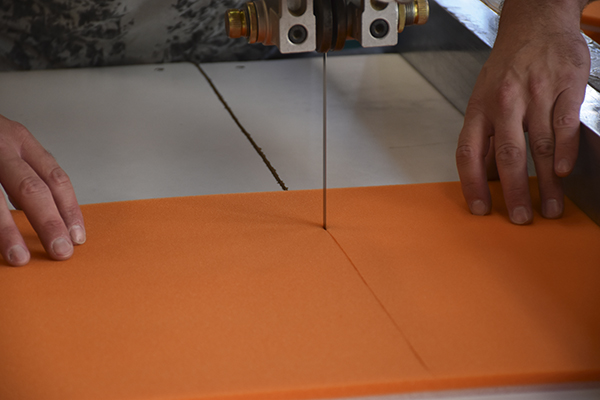
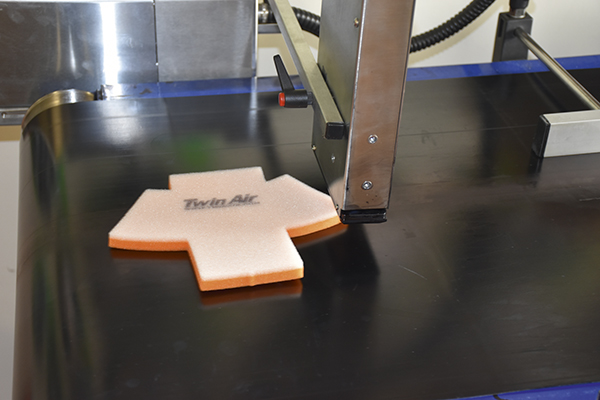
Manufacturing air filters for motorcycles is easy, right? It is simply a question of cutting, stamping, printing, gluing, assembly, pre-oiling (or not), packing and shipping, right? Think again! Robin Bradley visited Twin Air at Veghel in the Netherlands to see for himself just how much care and testing goes into every air filter…


Twin Air General Manager Pieter Does
 

Whether you are working with paper, cotton, foam, gauze and mesh or any other combination or kind of filter media technology, the process, and the importance of getting it right, is an attention-to-detail minefield and a primary critical component for engine performance.
Visiting Twin Air in the Netherlands reminded me just how much attention to detail needs to go into that process and just how a filter can affect performance. Twin Air has been a leading foam air filter manufacturer for almost 50 years and only makes motorcycle and ATV air filters - with off-road and motocross performance its speciality.


A major OE filter manufacturer, with the added reach of their aftermarket programme, Twin Air can claim to have been the filter of choice for “more World and National Champions than all other air filters combined”. Since 1972, Twin Air’s owner Klaas Biermann is proud of Twin Air’s record of having supported over 300 World Champions.
The Netherlands can claim a special place in the history of motocross - the country’s sandy, gritty soil is where it all began.
It was in the Netherlands, in 1947, that the Dutch national motorcycle federation hosted an international “scramble” for teams from Great Britain, Belgium and the Netherlands, and called it a “moto-cross.” While the sport’s popularity grew steadily over the next 25 years, one thing that remained constant was the stock paper air filter designs of the time. There was a paper filter with a single layer of foam, but even that didn’t cut it for protection - after 30 minutes it was shot. In those early days of motocross, engine failures were common.


"In 1972 Twin Air gave the motocross world a historic boost"


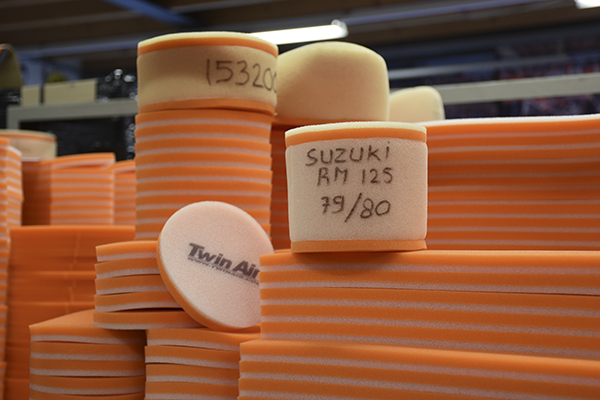
It was in 1972 that Twin Air gave the motocross world a historic boost with their revolutionary approach to air filter design - a laminated, dual-foam air filter that, when soaked in a special oil, allowed free airflow into the carburettor while keeping dirt, grime, sand and water out of it. It was effective, durable, washable and reusable. It took off, and the little start-up company that invented it hasn’t stopped ever since.
Today they are available for all motocross and ATV vehicles and distributed worldwide. Twin Air filters are OEM-specified for 20+ motorcycle companies, and the official air filter of worldwide factory teams such as Honda HRC, Kawasaki Racing Team, Yamaha Racing, Red Bull KTM, Rockstar Husqvarna and many more
Twin Air’s breakthrough was to recognise the two quite different and often competing characteristics needed from a motocross air filter - high air flow and maximum particulate restriction. Their answer was to double-up on the filtration process with a fused dual-layer design that is now the go-to standard air filter architecture, and while the principle is often copied, “nobody can get close to our level of quality and performance,” says Pieter Does, General Manager.


Brand Manager Bart Ghielen

“The fused layers of open-pore foam and fine inner foam layer trap even the smallest particles. The rounder design boosts airflow, and with a revolutionary micro-gluing process to minimise the seams - shorter seams mean more flow - we have a combination that makes it possible to maximise the protection for the engine and horsepower boosting performance of improved air flow volume and speed - where air flow is concerned speed means more speed - and that comes from minimum possible disruption and restriction of the air flow. In fact, we manufacture some models with a backfire-resistant foam layer laminated to the filter so we can even eliminate the restrictive stock backfire screen from the air box.


“As engine technology has advanced, so too filter technology has had to not just keep up, but be ahead of OE engineers’ requirements in order to help them access the full potential of the machines they are designing. One of our big achievements has been to specify a quality of foam, that means that the cells are evenly sized and distributed throughout the structure of the air cleaner, making for a smooth, predictable and consistent air flow, and that is a huge advantage to the engineers and to professional as well as amateur racers.
“This also means that our motorcycle and ATV filters are truly fully washable and durable - the structure is stable and uniform - and being able to reuse a Twin Air motorcycle or ATV filter at least 50 times is common. We also use a high-quality greaseless sealing ring, with every filter assembled by hand and inspected for a perfect fit.
“For many years Twin Air factory pre-oiled filters were only available to our top professional race teams and OEM customers. The results were so good that we now offer the same factory treatment to everyone.

“We start with an original dual-stage air filter and completely submerge it in BIO liquid power filter oil. After the filter is massaged to ensure all pores are evenly coated with oil, it’s placed in a temperature-controlled room to allow the oil to completely cure. You just open the resealable bag and install.
“Another Twin Air innovation is our range of PowerFlow kits. The best filter in the world can’t do its job if there are leaks in the seal of the airbox. Twin Air’s kits ensure a leak-proof, fool-proof fit with a rigid, lightweight billet aluminium cage that replaces the flimsy plastic stock cage, and a billet aluminium flange with a rubber seal that bolts tight to the airbox. PowerFlow kits for ATVs are custom-designed for each unique application for superior airflow, improved sealing surface, removal of the restrictive backfire screen and ease of service”.
While manufacturing precision and quality control is at the heart of the Twin Air operation, the R&D and testing are the brains. Twin Air meets and exceeds the requirements of several of the applicable stringent ISO tests, starting with ISO-5011 ‘Inlet Air Cleaning Equipment’ for internal combustion engines and compressors - ‘Performance Testing’.
 

"Tests are performed using ISO-12103-1 A4 Coarse Dust"

The ISO standard establishes and specifies uniform test procedures, conditions, equipment and a performance report to permit the direct laboratory performance comparison of air cleaners. The basic performance characteristics of greatest interest are air flow restriction or differential pressure, dust collection efficiency, dust capacity and oil carry-over on oil bath air cleaners. This test code therefore deals with the measurement of these parameters.
Brand Manager Bart Ghielen explained the testing procedures. “The first test is the Air Flow or Resistance test. The filter test set-up is equipped with a computer that can programme and control the fan that drives the air flow cycle and an air flow (pressure difference) sensor. 


“The sensor determines the air pressure before and after the filter under test. During the test, the air flow is increased, and the pressure drop over the filter is continuously measured. This automated test will give information about the air resistance of a filter plus other important air property measurements such as humidity, temperature and absolute air pressure. Twin Air has developed a computer software programme that fully automates the test cycle. This software is able to measure and process the data and make a first test report.”
Finally, the difference in air resistance of different filters is plotted to help future design development.


With all the ISO test procedures required, Twin Air constantly checks and monitors their materials and procedures in-house in their own test laboratory - both before manufacturing and their finished products (once assembled) - to ensure that every batch made and sold is fully compliant.
Dust tests are performed using the ISO-12103-1 A4 Coarse Dust Test. To understand filter performance and characteristics, research on dust behaviour in an air filter has been done to give the company a reference base-line by taking the closest possible look at the kind of dust that motorcycle air filters are subjected to by using a scanning electronic microscope. Images are taken of ISO approved test dust (yes, there is such a thing), then images are taken from the dust in the tested air filter and the dust in the reference ‘absolute filter’ - the ISO approved dust gauge testing screen.
Bart continued to explain that “during the dust test, a filter to be tested is placed inside the test set-up. After the filter under test, the reference filter is tested. After testing, the dust caught by the reference filter and the filter under test is measured to calculate the overall filter efficiency and the full life capacity (how much dust in grams that can be held by the filter before the resistance is increased by 5 mbar) and its efficiency (the percentage of dust that is caught by the filter).
 

"Fused layers of open-pore foam"

“The mass of the air filter and reference filter are important measurements for this test. The masses of the air filter and the reference are measured before the test. During the test, dust is automatically injected into an air flow that is controlled at a setpoint value. After the test, the masses of the air filter and reference are measured. While the test is underway, the mass of the dust in the air filter is calculated when the pressure drop over the filter exceeds 5 mbar relative to the initial air pressure drop over the air filter.”
ISO-5001 also requires a water seep-through test. The water tests are performed by spraying water onto the filter. The per second rate at which the amount of water sprayed on the filter during the test is prescribed by the test protocol. 


“The goal of the water test is to determine the amount of water required before the water will seep through the filter. To be able to measure the moment of seep-through, a sensor is placed inside the filter under test. This sensor can be designed or adjusted to meet the layout of the filter under test. It is important to follow the layout of a filter as closely as possible. The completely automated test will determine the time that was needed before a water seep-through relative to the amount of water sprayed on the filter during the test.”

TWIN AIR
www.twinair.com